Budget 2027: What It Means for Solar, Heat Pumps, EVs and Energy Bills
Budget 2027 has no electricity credit. Tax-free solar export income rises to €600, EV VRT relief runs to end 2028, Fuel Allowance rises to €43 with a €641 income limit, and carbon tax on heating oil and gas is cut. What is confirmed and what is not.
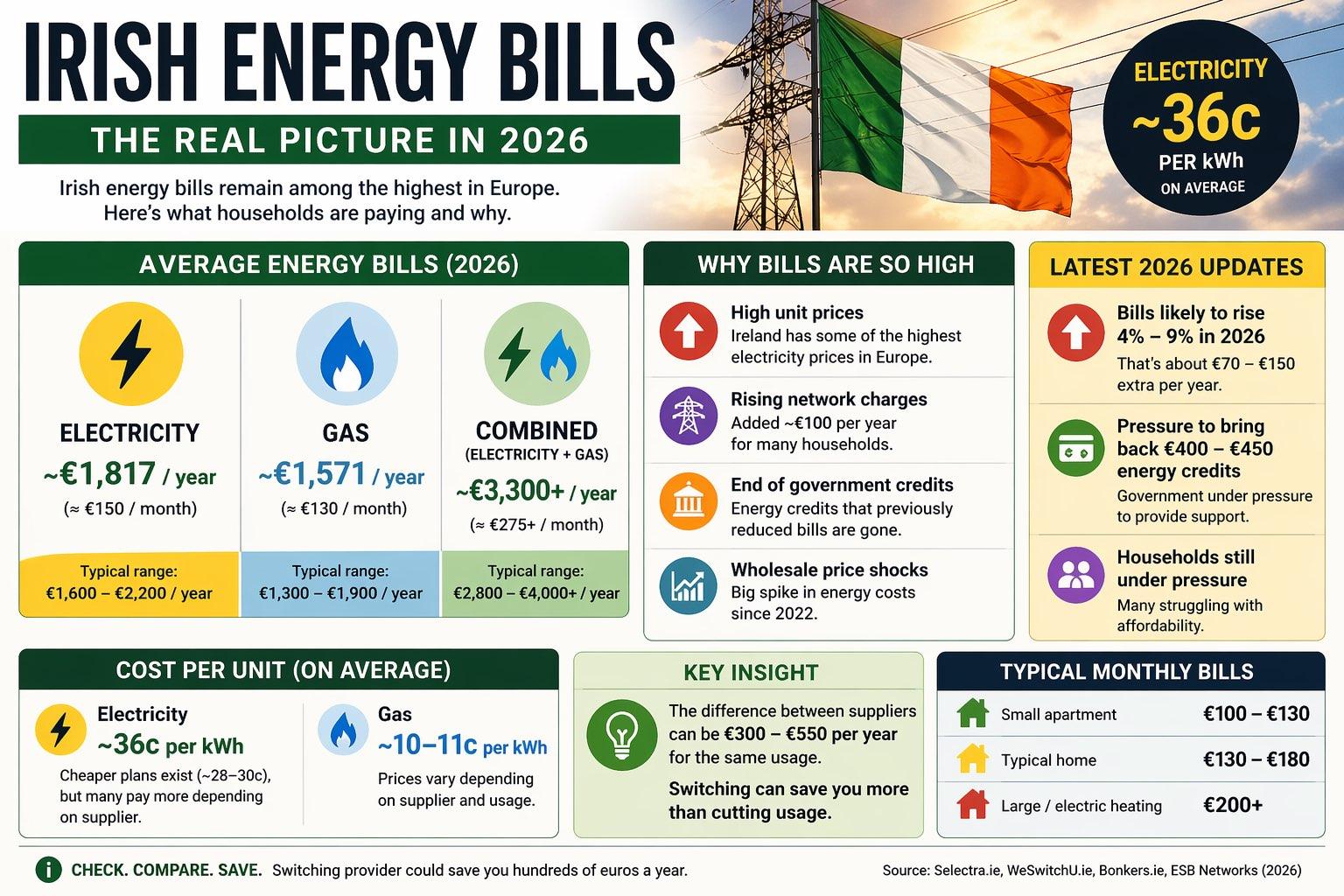
Budget 2027 was delivered on 6 October 2026. There is no universal electricity credit, for the second year in a row. The measures that matter for home energy are a higher tax-free threshold for solar export income, a two-year extension of the electric vehicle VRT relief, a €5 rise in Fuel Allowance with a higher income limit for single pensioners, and a carbon tax cut on home heating oil and gas.
This is a summary of the energy measures, taken from same-day reporting by RTÉ, The Irish Times and others, listed at the end. Several start dates had not been published when we wrote this, and we have marked those clearly.
Budget 2027 energy measures at a glance
| Measure | What changes |
|---|---|
| Universal electricity credit | None |
| Tax-free solar export income | €400 to €600 a year |
| VAT on electricity and gas | Stays at 9% until 2030 |
| Fuel Allowance | Up €5 to €43 a week |
| Fuel Allowance income limit, single person aged 66 or over | €534 to €641 a week |
| Carbon tax on kerosene and natural gas | Cut to €48.50 a tonne |
| VRT relief on electric vehicles | Extended to 31 December 2028 |
| SEAI residential and community upgrade schemes | €654.5 million |
No energy credit in Budget 2027
There is no universal electricity credit in Budget 2027. The last one was €250, paid in two €125 instalments between November 2024 and February 2025, and Budget 2026 dropped them. The Taoiseach had signalled this on 7 September 2026, saying he could not see the capacity for energy credits for everybody.
The Government's help with bills is targeted instead. The 9% VAT rate on electricity and gas continues until 2030, and Fuel Allowance rises. Our energy credit page has the full history of the credits and the supports that remain. With several suppliers raising prices this month, the quickest saving for most households is still to switch to a cheaper electricity plan.
Solar panels: €600 of export income tax-free
The tax-free threshold for income from selling surplus solar electricity to the grid rises from €400 to €600 a year. Reporting on the day put the start at 1 January 2027; the detail will be in the Finance Bill.
Most homes will not notice a difference. A typical 4 kWp system exports 1,500 to 2,000 kWh a year, which earns roughly €285 to €380 at current rates, already under the old limit. The change helps larger systems of about 6 kWp and up, and homes on the best export rates, which could earn more than €400 and would otherwise have had to declare the excess. See selling electricity back to the grid for export rates by supplier.
The Budget did not change the solar grants themselves. Those changed a week earlier in the SEAI package that opened on the same day as the Budget: the solar PV grant of up to €1,800 now covers homes built before 2025, and there is a new €600 battery grant. Our post on the October 2026 SEAI grant changes covers those in full.
€654.5 million for SEAI grants
Budget 2027 allocates €654.5 million to SEAI residential and community energy upgrade schemes, which fund the retrofit grants, the solar grants and the new boiler scrappage grant. RTÉ reported that as a rise of about 2% on the previous year's €640 million. The practical point for homeowners is that the grants are funded for 2027 at their current rates. The SEAI grants guide lists every grant and who qualifies.
Heat pumps: cheaper oil and gas, same grants
Carbon tax on kerosene and natural gas is cut to €48.50 a tonne, and the Minister for Finance said the rate will stay there for the lifetime of the Government. The Government estimates that saves about €86 on a 1,000 litre fill of home heating oil and about €65 a year for a home heated with gas.
That slightly narrows the running-cost gap between a boiler and a heat pump, but not by much: a heat pump typically saves several hundred euro a year over oil. The grants are unchanged by the Budget, at up to €12,500 for the heat pump plus €2,000 boiler scrappage. See heat pump costs in Ireland and SEAI boiler replacement grants.
Electric cars: VRT relief to the end of 2028
The VRT relief of up to €5,000 on new battery electric vehicles was due to end on 31 December 2026. Budget 2027 extends it by two years, to 31 December 2028. VRT rates rise by 1% on higher-emission cars, which electric vehicles avoid.
The carbon tax increase on petrol and diesel that was due this month is paused, with rises now scheduled for 1 May and 13 October 2027. Our guides to the most popular electric cars in Ireland and home EV chargers cover the grants that sit alongside the VRT relief.
Pensioners: more people will qualify for free upgrades
Fuel Allowance rises by €5 to €43 a week. More importantly, the income limit for a single person aged 66 or over rises from €534 to €641 a week.
That matters beyond the payment itself, because Fuel Allowance is the most common way into the Warmer Homes Scheme, which pays for home energy upgrades in full and now includes solar panels and a battery as standard. A single pensioner with income between €534 and €641 a week who did not qualify before may now do so. See SEAI grants for pensioners and free solar panels in Ireland.
Farms
Budget 2027 includes a record €93 million for TAMS, the on-farm investment scheme that grant-aids solar panels on farm buildings. See our guide to solar panels for farms.
What is not confirmed yet
- Start dates for the Fuel Allowance changes. Neither the date the €43 rate begins nor the date the €641 limit applies had been published when we checked on 6 October 2026.
- The income limit for couples. Only the single-person figure was reported. The current limit for a couple is €1,068 a week.
- The legal detail of the €600 export threshold. The Finance Bill will confirm the start date and whether the exemption still ends on 31 December 2028.
- The Energy Affordability Action Plan. The Government says it will publish this in the weeks after the Budget.
We will update this page and the guides linked above as the Department of Social Protection, Revenue and SEAI publish the detail.
Sources
John Rooney is the editor of Solar Info and has been covering the Irish solar energy market since 2023. He fact-checks all content against official SEAI data and maintains relationships with SEAI-registered installers across Ireland.