What Are Solar Panels? A Beginner's Guide for Irish Homeowners
What are solar panels and how do they work? Plain-English guide covering types, costs, how they generate electricity, and whether they work in Ireland's climate.
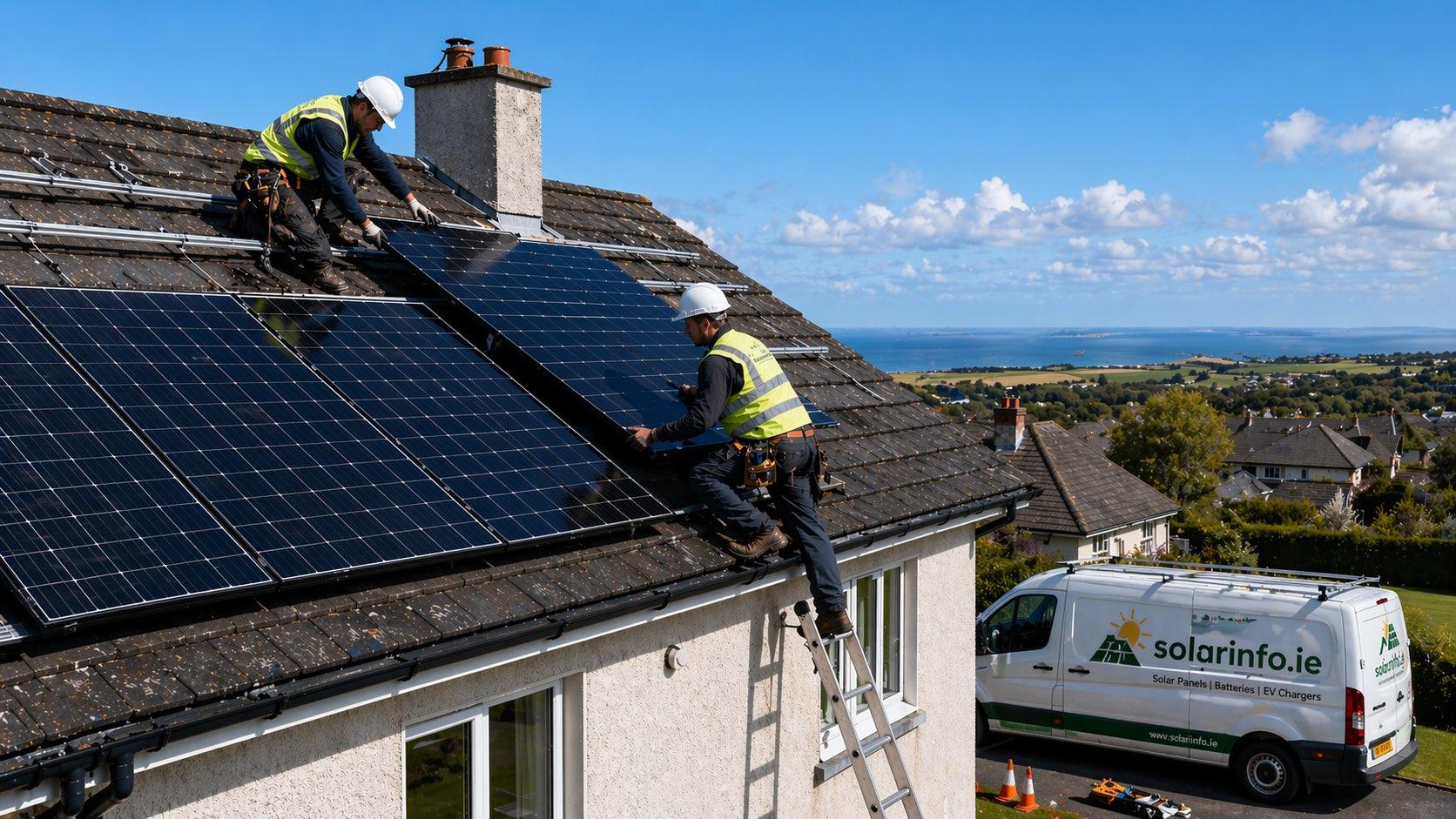
Solar panels are devices that convert sunlight into electricity. They sit on your roof or in your garden, absorb light energy from the sun, and produce electricity you can use to power your home. Any electricity you don’t use can be sold back to the grid.
In Ireland, a typical home solar panel system produces enough electricity to cut your annual bill by 50–70%. Combined with the SEAI grant of up to €1,800 and 0% VAT, solar panels have become one of the most popular home energy upgrades in the country.
How do solar panels actually work?
Solar panels are made up of many individual photovoltaic (PV) cells — typically 60 or 72 per panel. Each cell is a thin wafer of silicon, a semiconductor material. Here’s the basic process:
- Sunlight hits the panel. Photons (particles of light) strike the silicon cells. This works in all daylight conditions — not just direct sunshine. Ireland’s overcast skies still produce plenty of diffuse light that panels can use.
- Electrons are knocked loose. The photons transfer energy to electrons in the silicon, freeing them from their atoms. This creates an electrical current — the photovoltaic effect, discovered in 1839.
- DC electricity flows. The freed electrons flow through the cell as direct current (DC) electricity — the same type a battery produces.
- An inverter converts to AC. Your home runs on alternating current (AC), so an inverter converts the DC output into usable AC electricity.
- You use or export it. The AC electricity powers your home. Any surplus is automatically exported to the grid, earning you a feed-in tariff (typically 15–24c/kWh in Ireland).
For a more detailed explanation, see our full guide on how solar panels work.
What are solar panels made of?
The key material is silicon, the same element used in computer chips. There are two main types of solar cell:
Monocrystalline
Made from a single crystal of silicon. These are the black panels you see on most modern installations. They’re more efficient (20–22% typically) and perform better in low light, making them the preferred choice in Ireland. More expensive per panel, but you need fewer panels to produce the same output.
Polycrystalline
Made from multiple silicon crystals melted together. These have a blue, speckled appearance and are slightly less efficient (15–18%). They’re cheaper per panel but you may need more of them. Less common in new installations as the price gap with monocrystalline has narrowed significantly.
A typical solar panel also includes a glass front layer (for protection), an aluminium frame, a backsheet, and wiring. The whole unit is sealed and weatherproof — designed to last 25–30 years outdoors. See our solar panel brands guide for a comparison of what’s available in Ireland.
Types of solar panels
When people say “solar panels,” they usually mean solar PV (photovoltaic) panels that generate electricity. But there are actually two types:
| Solar PV panels | Solar thermal panels | |
|---|---|---|
| What they produce | Electricity | Hot water |
| How they work | Photovoltaic effect (light to electricity) | Sunlight heats fluid in tubes |
| Typical cost | €7,000–€9,000 (4 kWp) | €3,000–€5,000 |
| SEAI grant | Up to €1,800 | Up to €1,200 |
| Best for | Reducing electricity bills, powering appliances | Heating water only |
| Popularity | By far the most common choice | Less common (PV is more versatile) |
Solar PV is the standard choice for Irish homes because electricity is more expensive than gas/oil for heating water, and PV panels can power everything in your home — not just hot water. Read more in our solar thermal vs PV comparison.
What can solar panels power in your home?
Solar panels produce regular electricity — exactly the same as what comes from the grid. They can power anything in your home:
- Lighting, appliances, TVs, computers
- Washing machine, dryer, dishwasher
- Electric cooker and kettle
- Heat pumps (a great combination with solar)
- EV charging
- Immersion heater (via a smart diverter like an Eddi or iBoost)
The key is timing. Solar panels produce electricity during daylight hours, so running appliances during the day maximises your savings. Any electricity you don’t use is exported to the grid. Adding a battery lets you store surplus electricity for evening use.
How much do solar panels cost in Ireland?
A typical residential system costs €7,000–€9,000 for a 4 kWp system (10 panels) before the SEAI grant. After the grant of up to €1,800 and 0% VAT, your net cost is around €5,200–€7,200.
Payback is typically 5–7 years, after which you get free electricity for another 18–20 years. Over 25 years, total savings reach €20,000–€25,000.
For a full breakdown, see our solar panel cost guide or use our solar savings calculator to estimate your returns.
Do solar panels work in Ireland’s climate?
Yes. This is the most common concern, and it’s understandable — Ireland isn’t exactly known for sunshine. But solar panels don’t need direct sunlight to produce electricity. They work with daylight, including the diffuse light that comes through clouds.
Ireland receives between 900–1,100 kWh/m² of solar radiation per year, depending on location. The south and south-east get the most, but even the north-west generates enough for a strong financial return. A typical 4 kWp system produces around 3,400–3,800 kWh per year — roughly equivalent to an average Irish household’s annual electricity consumption.
Output is highest from April to September and lowest in December and January. See our winter performance guide and solar irradiance map for county-by-county data.
How long do solar panels last?
Modern solar panels are designed to last 25–30 years and come with manufacturer warranties guaranteeing at least 80% of original output after 25 years. In practice, most panels continue producing well beyond their warranty period — degradation is typically only 0.3–0.5% per year.
Panels have no moving parts, require very little maintenance, and are built to withstand rain, wind, and hail. The inverter typically needs replacing once during the system’s lifetime (after 10–15 years, costing €800–€1,500).
Frequently Asked Questions
What are solar panels made of?
Solar panels are primarily made of silicon cells, protected by tempered glass on the front and a polymer backsheet. The cells are wired together and sealed in an aluminium frame. Monocrystalline panels (black, single-crystal silicon) are most common in Ireland due to their higher efficiency.
How many solar panels does a house need?
A typical Irish home needs 8–12 panels (3–5 kWp). The exact number depends on your electricity usage, roof space, and panel wattage. See our sizing guide for a detailed breakdown.
Do solar panels work at night?
No. Solar panels need light to produce electricity, so they don’t generate power at night. During the evening, you draw electricity from the grid as normal — or from a battery if you have one installed.
Do solar panels increase house value?
Yes. Solar panels improve your BER rating, which directly affects property value. A better BER makes your home more attractive to buyers and can influence mortgage rates.
Can I install solar panels myself?
While it’s technically possible to buy panels, you must use an SEAI-registered installer to qualify for the €1,800 grant. Electrical connections must be done by a registered electrical contractor. DIY installation is not recommended and will void most warranties.
Sources
- SEAI: Solar Electricity Grant, seai.ie
- PVGIS: Solar Irradiance Data for Ireland, re.jrc.ec.europa.eu
- Citizens Information: Grants for Solar Panels, citizensinformation.ie
John Rooney is the editor of Solar Info and has been covering the Irish solar energy market since 2023. He fact-checks all content against official SEAI data and maintains relationships with SEAI-registered installers across Ireland.