Electricity Prices Rise 8% in July 2026: What It Means for Irish Homes
Electric Ireland is raising electricity prices 8% and gas 7.7% from 1 July 2026, adding €138 a year to the average electricity bill. Here's the full breakdown, why it's happening, and how solar panels blunt the impact.
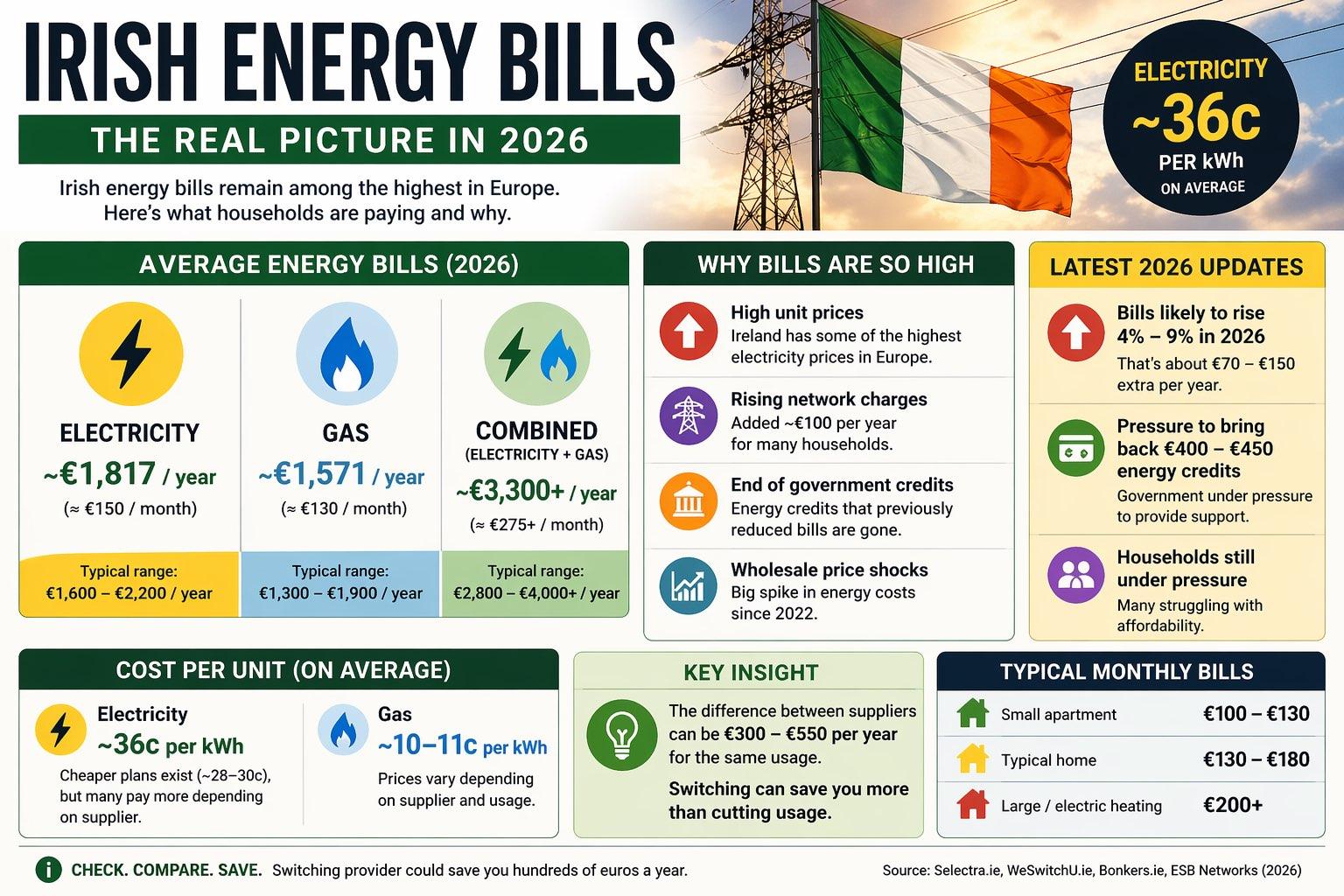
Irish households are facing another increase to their energy bills. Electric Ireland, the country's largest electricity supplier, has confirmed it will raise residential electricity prices by 8% and gas prices by 7.7% from 1 July 2026. It's the company's first price rise since October 2022, and it lands on around 1.1 million electricity customers and 145,000 gas customers. The increase was confirmed in Electric Ireland's 28 May press release and reported by RTÉ.
For most homeowners the question is simple: how much more will this cost, and is there anything I can actually do about it? Here's the full breakdown, why prices are climbing again, and how a solar panel system changes the maths.
How Much More Will You Pay?
Electric Ireland says the average residential customer will see the following increase from 1 July 2026:
| Increase | Per year | Per week | |
|---|---|---|---|
| Electricity | +8% | ~€138 | ~€2.66 |
| Gas | +7.7% | ~€117 | ~€2.25 |
A household on both electricity and gas is therefore looking at roughly €255 a year in extra costs. That may not sound dramatic on a weekly basis, but it compounds: Irish bills have ratcheted upward repeatedly since 2021, and even after recent falls from the 2022–23 peak, Ireland still has among the highest electricity prices in the EU — roughly 40% above the European average.
Why Are Prices Rising Again?
Electric Ireland attributed the increase to sustained volatility in wholesale energy costs. Pat Fenlon, the company's executive director, pointed to conflict in the Middle East continuing to drive up the price of the gas that sets the marginal cost of electricity on the Irish grid.
This is the uncomfortable structural reality of the Irish electricity market: a large share of our power is still generated by gas plants, so when international gas prices spike, the price of electricity follows — regardless of how much wind is on the system that day. Until Ireland's grid is far less dependent on imported fossil fuel, household bills will keep tracking events thousands of kilometres away.
It's worth being honest about one thing. Switching supplier can shave money off your unit rate, and it's always worth comparing. Every announced rise from every supplier is tracked on our electricity price increases page. But over the past 18 months nearly every major Irish supplier has raised prices, because they're all exposed to the same wholesale market. Switching changes what you pay per unit. It does nothing about how many units you have to buy.
This Is Where Solar Changes the Equation
Every electricity price increase has the same quiet side effect: it makes the electricity you generate yourself more valuable. Solar panels don't lower the grid rate. They reduce how much of it you need.
A typical 4 kWp solar array on an Irish home generates around 3,400 kWh a year. With sensible daytime usage, most homes self-consume 50–70% of what they produce, directly displacing units they'd otherwise buy from the grid. The rest is exported and paid for under the Clean Export Guarantee.
The key point: as the grid price rises, the value of each self-consumed unit rises with it. A solar system sized to your home effectively locks in a chunk of your electricity at today's installation cost, insulated from the next round of wholesale volatility. Put plainly: the 8% increase that hits your neighbour's full bill only hits the portion of yours you still import.
What the Increase Does to Solar Payback
Counter-intuitively, rising grid prices are good news for the economics of solar. The faster grid electricity gets, the faster panels pay for themselves, because every unit you avoid buying is now worth more. A system that looked like a 7–8 year payback at last year's rates moves closer to 6–7 years with each increase. After that, the generation is essentially free for the 20–25 year life of the panels.
Add the SEAI grant of up to €1,800 for eligible homes, and the upfront cost drops further. Use our solar savings calculator to estimate the payback for your own roof and usage.
Adding a Battery: Beating the Evening Peak
Solar alone handles your daytime electricity. The expensive part of the day, though, is the 5pm–7pm evening peak, when demand is highest and gas plants set the price, exactly when your panels are winding down. That's the gap a home battery fills.
A battery stores surplus solar generated during the day (or cheap overnight electricity) and discharges it during the peak, so you ride through the most expensive hours without drawing from the grid. With Ireland's rollout of dynamic electricity tariffs in 2026, the savings from a well-scheduled battery have grown substantially — the price gap between the cheapest and most expensive half-hour of the day is often 20–40c/kWh.
For a household worried about repeated price hikes, the solar + battery combination is the most complete hedge available: panels cut your daytime imports, and the battery covers the evening peak that price increases hit hardest.
What You Can Do Right Now
- Compare your tariff. Check whether you're on Electric Ireland's standard plan and whether a fixed-rate or alternative supplier deal currently undercuts it. This is a short-term lever, not a long-term fix.
- Get a smart meter. ESB Networks fits them free. It's a prerequisite for night-rate and dynamic tariffs, and it gives you real visibility into when your home actually uses power.
- Shift flexible loads. Dishwashers, washing machines, EV charging and immersion heating run cheaper overnight or — if you have solar — in the middle of the day.
- Price up solar. With grid prices rising and the SEAI grant still in place, the payback case is stronger than it was a year ago. Get quotes from SEAI-registered installers in your area and compare them properly.
Frequently Asked Questions
How much are electricity prices going up in Ireland in July 2026?
Electric Ireland is raising residential electricity prices by 8% and gas by 7.7% from 1 July 2026. For the average customer that's about €138 extra a year on electricity (roughly €2.66 a week) and €117 a year on gas. The change affects around 1.1 million electricity customers.
Why are electricity prices rising again?
Electric Ireland attributed the increase to sustained volatility in wholesale energy costs driven by conflict in the Middle East. It's the company's first price rise since October 2022. Ireland already has among the highest electricity prices in the EU, roughly 40% above the European average.
Will solar panels protect me from electricity price rises?
Partly. Solar panels cut the number of units you buy from the grid, so every price increase makes the electricity you self-generate more valuable. A typical Irish home offsets 50–70% of its annual usage with solar, and adding a battery pushes that higher by storing daytime generation for the expensive evening peak.
Does the SEAI grant still apply in 2026?
Yes. The SEAI Solar PV grant of up to €1,800 is still available in 2026 for eligible homes built and occupied before 2025. Combined with rising grid prices, it shortens the payback period on a typical solar installation.
Can I switch supplier to avoid the increase?
Switching can save money in the short term, but every major Irish supplier has raised prices over the past year and wholesale costs affect them all. Switching reduces your rate; solar reduces the number of units you buy at any rate. The two strategies stack.
The Bottom Line
The July 2026 increase is another reminder that Irish energy bills are tied to international fuel markets no household can control. You can chase the best tariff — and you should — but the only way to meaningfully shrink your exposure is to buy fewer units from the grid in the first place.
Solar panels do exactly that, and every price rise makes them pay back a little faster. If repeated bill increases have you frustrated, it's a good moment to run the numbers. Start with our savings calculator, read whether solar panels are worth it in Ireland, then get quotes from trusted local installers.
John Rooney is the editor of Solar Info and has been covering the Irish solar energy market since 2023. He fact-checks all content against official SEAI data and maintains relationships with SEAI-registered installers across Ireland.