Dynamic Electricity Tariffs Ireland 2026: Why They're a Game-Changer for Solar + Battery Homes
All five major Irish electricity suppliers must offer dynamic tariffs by 1 June 2026. Here's how solar + battery owners can save €400+ a year through wholesale-linked half-hourly pricing.
Update: the plans are now on sale. For every dynamic tariff compared, verified base rates and price caps, and today's day-ahead prices in c/kWh, see our dynamic electricity tariffs in Ireland guide.
From 1 June 2026, every major electricity supplier in Ireland will be required to offer a dynamic tariff: a plan where your unit rate changes every 30 minutes based on the wholesale price of electricity. For most households this is a curiosity. For households with solar panels and a battery, it's the most significant change to home energy economics since the Clean Export Guarantee.
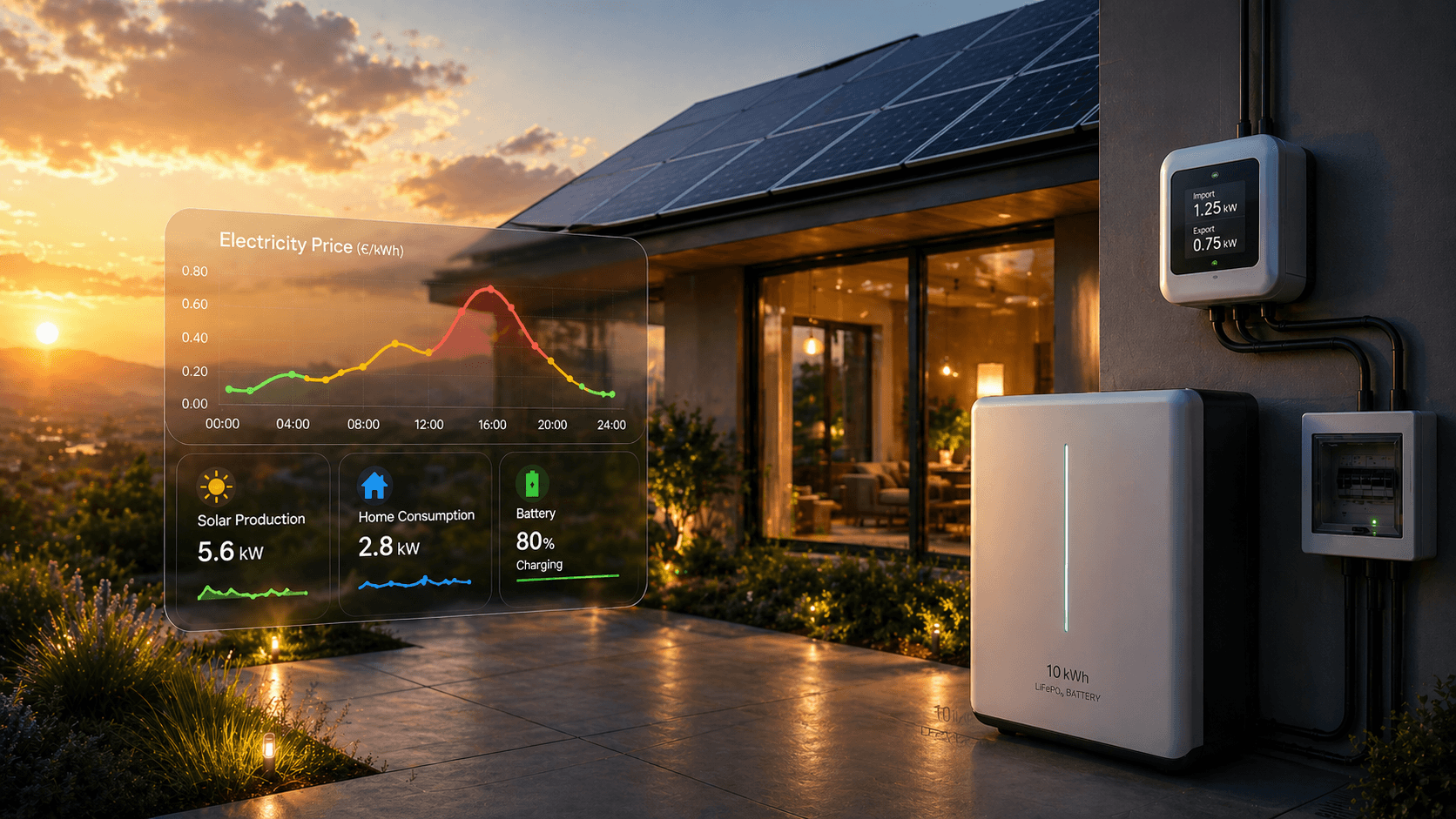
The reason is simple: a battery lets you buy electricity when it's cheap and use it when it's expensive. Without a battery, dynamic tariffs are mostly about remembering not to run the tumble dryer at 6pm. With one, your home becomes a small arbitrage operation, and the savings can be hundreds of euros a year on top of what your panels already deliver.
What Is a Dynamic Electricity Tariff?
A dynamic tariff (sometimes called a real-time or wholesale-linked tariff) ties your import unit rate to the half-hourly Irish wholesale electricity market. Every 30 minutes the price changes, sometimes by a few cents, occasionally by 30c or more. Tomorrow's prices are published a day in advance, so you can see exactly when electricity will be cheapest and plan around it.
Your bill has three components:
- Standing charge: a fixed daily amount, the same as on a standard plan.
- Base unit rate: a fixed per-kWh charge that covers network costs, PSO levy, and supplier margin.
- Dynamic unit rate: a variable per-kWh charge that tracks the wholesale market and updates every half hour.
The Commission for Regulation of Utilities (CRU) requires suppliers to publish a price cap on extreme spikes and to send a day-ahead alert if the next day's prices are unusually high. You won't wake up to a €5/kWh shock.
Which Irish Suppliers Will Offer Dynamic Tariffs?
By 1 June 2026, all five of the largest electricity suppliers in Ireland must offer at least one dynamic tariff:
- Bord Gáis Energy
- Electric Ireland
- Energia
- PrePay Power / Yuno
- SSE Airtricity
You'll need a smart meter to be eligible, without half-hourly meter readings, the supplier can't bill you on a half-hourly rate. The good news is that the National Smart Metering Programme has now installed smart meters in over 80% of Irish homes. If you don't have one yet, ESB Networks will fit one for free.
Why Dynamic Tariffs Are a Big Deal for Solar + Battery Homes
Standard time-of-use tariffs in Ireland are crude, typically a "night rate" of around 14–18c/kWh from 11pm to 8am and a higher day rate the rest of the time. That's fine for charging an EV overnight, but it doesn't reflect what's actually happening on the grid.
Wholesale prices in Ireland regularly drop close to zero, and occasionally negative, during windy nights when wind farms generate more than the grid can use. Conversely, prices spike on still winter evenings between 5pm and 7pm when demand peaks and gas plants set the marginal price. The gap between cheapest and most expensive half-hour in a single day is often 20–40c/kWh.
A solar + battery home can exploit that gap in three ways:
- Charge the battery from the grid during the cheapest 30-minute windows (often 2am–5am on windy nights), then discharge it during the 5pm–7pm peak. You're effectively buying electricity at 4c and avoiding paying 38c, a 34c/kWh saving per cycled unit.
- Hold solar generation in the battery until peak pricing instead of exporting it at the standard CEG rate. If your export tariff pays 20c but the grid is paying 35c at 6pm, your battery effectively earns the difference.
- Avoid expensive imports entirely. Even without aggressive arbitrage, simply not drawing from the grid during peak half-hours saves real money.
Worked Example: 4 kWp Solar + 5 kWh Battery on a Dynamic Tariff
Let's take a typical Irish household: 4,500 kWh annual consumption, a 4 kWp solar array generating ~3,400 kWh/year, and a 5 kWh battery. Here's how the same setup performs on different tariffs:
| Standard tariff | Day/night tariff | Dynamic tariff | |
|---|---|---|---|
| Average import rate | ~38c/kWh | ~32c/kWh blended | ~22c/kWh blended |
| Battery charging strategy | Solar only | Solar + night rate | Solar + cheapest half-hours |
| Annual import bill | ~€950 | ~€780 | ~€520 |
| Export earnings (CEG) | ~€280 | ~€280 | ~€240* |
| Net annual electricity cost | ~€670 | ~€500 | ~€280 |
*Slightly lower export earnings on a dynamic tariff because the battery holds more solar for self-use rather than exporting it, but the import savings far outweigh this.
On these numbers, switching from a standard tariff to a dynamic tariff with a properly scheduled battery saves around €390 a year. Over the 10–15 year warranty life of a typical home battery, that's €4,000–€6,000, enough to noticeably shorten the payback period of the battery itself.
Dynamic Tariffs + EV Charging
If you have a home EV charger, dynamic tariffs are arguably even more valuable than the solar+battery case. A typical EV pulls 7 kW for several hours per charging session, that's the single biggest controllable load in most homes. Smart chargers like the Zappi, Wallbox Pulsar, or Easee can be scheduled to only charge during the cheapest half-hours of the night.
Charging an EV at 4c/kWh instead of 38c/kWh saves around €2.40 per full charge on a 70 kWh battery. Over 12,000 km of driving a year (~3,000 kWh of charging), that's another €700–€900 in savings on top of the solar+battery numbers above.
What You Need to Make a Dynamic Tariff Work
1. A smart meter (free from ESB Networks)
Non-negotiable. The supplier needs half-hourly readings to bill you correctly. If you've blocked smart meter installation, you can't be on a dynamic tariff.
2. A battery with API-based or schedulable charging
Most modern home batteries can be scheduled to charge during defined windows. The best for dynamic-tariff users are those that integrate with third-party energy management platforms or have open APIs, for example:
- GivEnergy: strong scheduling, good app, popular with installers in Ireland.
- Tesla Powerwall: excellent automation but the integration with Irish dynamic tariffs depends on supplier app support.
- Sigenergy SigenStor: gaining traction in Ireland, supports time-of-use and dynamic charging schedules.
- SolarEdge Home Battery: works with the SolarEdge inverter ecosystem, good scheduling controls.
- Huawei LUNA2000: common with Bord Gáis installs, supports time-of-use scheduling.
3. A hybrid inverter (or AC-coupled battery inverter)
Your inverter needs to be able to charge the battery from the grid as well as from solar. Most modern hybrid inverters (SolarEdge, GivEnergy, Sigenergy, Huawei, Sungrow, Solis) support this, but it's worth confirming with your installer that "grid charging" or "force charge" mode is enabled. Some legacy installs lock this out by default.
4. A supplier app or third-party tool that exposes half-hourly prices
You need to know tomorrow's prices to schedule the battery. The five mandated suppliers will all publish half-hourly rates a day ahead, typically through their own app. Third-party tools and integrations are emerging that automate the optimisation, watch this space over 2026.
Pitfalls to Watch For
- Battery cycling cost. Every full charge/discharge cycle slightly degrades the battery. Aggressive arbitrage on tiny price gaps may cost more in degradation than it saves. Most modern lithium iron phosphate (LFP) batteries are rated for 6,000+ cycles, so this is less of a concern than it used to be, but it's a real factor.
- Standing charges. Some dynamic tariffs have higher standing charges than standard plans. If you're a low-usage household, the standing charge can wipe out your unit-rate savings.
- Export rate trade-offs. Some suppliers offer a lower CEG export rate on dynamic tariffs than on their standard plans. Always compare the net position, not just the import rate.
- Manual vs automated. If you don't automate, you'll need to actively manage your consumption. Most households quickly stop checking the app, pick a battery that handles scheduling for you.
Who Should, and Shouldn't, Switch to a Dynamic Tariff
Strong fit:
- Solar + battery households (especially batteries 5 kWh and above)
- EV households with a smart charger
- Homes with a heat pump and a hot water buffer tank
- Households that already shift consumption around night-rate windows
Probably not worth it:
- Apartments and small homes with low total consumption
- Households with no battery, no EV, and no shiftable loads
- Homes without a smart meter (or where the occupier blocked installation)
- Anyone who finds the idea of monitoring half-hourly prices stressful and doesn't have automation handling it
How Dynamic Tariffs Change the Case for Adding a Battery
Until now, the financial case for adding a battery to an Irish solar installation has been borderline. The price gap between import (~38c) and export (~20c) is around 18c/kWh, meaning each kWh you cycle through the battery saves you 18c. With a 5 kWh battery cycling once a day, that's around €330 a year, a 12–15 year payback at typical battery prices.
Dynamic tariffs change this. The effective price gap a battery exploits widens from 18c to 30c+ once you factor in arbitraging cheap overnight imports against expensive evening peaks. The same 5 kWh battery cycled twice a day (once for solar storage, once for grid arbitrage) can save €500–€700 a year, pulling the payback period in to 7–10 years, well within the warranty life.
If you've been on the fence about adding storage to an existing solar system, the rollout of dynamic tariffs in June 2026 is the strongest argument yet to do it.
Frequently Asked Questions
What is a dynamic electricity tariff in Ireland?
A dynamic electricity tariff is a plan where your import unit rate changes every 30 minutes based on the half-hourly wholesale price of electricity. From 1 June 2026, all five major Irish electricity suppliers must offer at least one dynamic tariff. You need a smart meter to qualify.
Are dynamic tariffs worth it if I have solar panels?
Solar panels alone don't benefit much from dynamic tariffs because you're already self-consuming when prices are typically high (during the day). The big wins come when you pair solar with a battery, the battery lets you buy cheap overnight electricity and avoid expensive evening imports.
Which is the best dynamic tariff for solar and battery in Ireland?
It depends on the supplier's combination of import rates, standing charge, and CEG export rate. As of 2026, dynamic tariffs are still rolling out, compare the net annual cost across all three components, not just headline import rates. The best deal for an EV-only household may be different from the best deal for a solar+battery household.
Do I need a smart meter for a dynamic tariff?
Yes. Dynamic tariffs are only available to homes with a smart meter, because the supplier needs half-hourly meter readings to bill correctly. ESB Networks fits smart meters free of charge.
Can a dynamic tariff make my bill higher?
Yes, if you can't shift consumption away from peak hours. Households with no flexibility (no battery, no EV, fixed daily routines around 5–7pm) may pay more on a dynamic tariff than on a standard one. Always compare against your current tariff before switching.
Will a battery automatically charge from cheap dynamic-tariff windows?
Only if it's configured to. Most modern batteries (GivEnergy, Sigenergy, SolarEdge, Tesla, Huawei) support time-of-use and forced grid charging, but the schedule has to be set up. Some installers will configure this for you; others leave it as a self-service setting in the app.
The Bottom Line
Dynamic tariffs aren't a silver bullet, they're a tool. For an apartment with no flexibility, they're a curiosity. For a home with solar, a battery, and an EV, they're the closest thing Ireland has to a true energy upgrade since the SEAI grant. The rollout deadline of 1 June 2026 means every major supplier will have at least one dynamic option this year.
If you already have solar and you're thinking about adding a battery, run the numbers with dynamic-tariff savings included, the payback case is materially better than it was 12 months ago. If you're starting from scratch, factor a hybrid inverter and battery-ready setup into your system design from day one.
Use our solar savings calculator to estimate your returns, or browse SEAI-registered installers in your area to get quotes from installers who can configure battery scheduling correctly.
John Rooney is the editor of Solar Info and has been covering the Irish solar energy market since 2023. He fact-checks all content against official SEAI data and maintains relationships with SEAI-registered installers across Ireland.